close
Choose Your Site
Global
Social Media
Views: 0 Author: Site Editor Publish Time: 2026-06-02 Origin: Site
Upgrading a motorcycle headlamp is rarely a simple plug-and-play scenario. Extreme space constraints and intense high-frequency vibrations make the process surprisingly tricky. Unpredictable stator limitations also add complexity. Most car upgrades do not face these same punishing environments.
Pushing raw lumen output into a housing is useless if the resulting beam blinds oncoming traffic. Furthermore, the cooling mechanism will quickly fail if trapped under a restrictive fairing. Airflow is strictly limited in these spaces. Riders need a smart upgrade path instead of just buying a brighter bulb.
This guide evaluates two of the most viable solutions for motorcycles. We look closely at passive-cooled CSP copper strip LEDs and micro-projector lens LEDs. We will help you navigate fitment realities, thermal management, and optical precision. By the end, you can make an evidence-based upgrade decision tailored perfectly to your specific bike.
Space dictates the choice: CSP copper strip LEDs offer the best physical compatibility for tight motorcycle housings.
Optics dictate the safety: Mini projector LEDs provide a superior, glare-free cutoff line but require significantly more housing clearance.
Accuracy over raw output: A high-quality LED must replicate the original halogen filament position within a 0.5mm tolerance to utilize the reflector correctly.
Cooling reliability: Passive cooling (copper braids) eliminates the risk of mechanical fan failure from road dust and moisture.
Motorcycles present a uniquely hostile environment for aftermarket electronics. Unlike spacious car engine bays, you have extremely limited rear-housing clearance. The space behind the headlight assembly leaves almost no room for error. Bulky heat sinks or active cooling fans often prevent dust covers from closing. If you cannot seal the housing, moisture will quickly destroy the internal reflector bowl.
Vibration and element exposure add another layer of difficulty. Motorcycle components face constant high-frequency vibrations. They also endure direct weather exposure. Moving parts carry a higher failure risk in these conditions. A tiny cooling fan can easily choke on road dust or seize up after heavy rain. When a mechanical fan fails, the LED chip overheats and dies within minutes.
You must also follow the strict 0.5mm filament rule. Throwing a high-power LED headlight for motorcycle into a stock reflector is dangerous unless the chips match the factory design. The LED chips must precisely replicate the exact physical location of the original halogen filament. Misalignment by even one or two millimeters destroys the beam focus. It generates severe vertical glare. This blinds oncoming drivers and reduces your actual nighttime visibility.
Measure bucket depth: Check the millimeter clearance from the bulb socket to the rear dust cap.
Assess weather seals: Ensure any aftermarket wiring boots still provide a watertight barrier.
Verify chip alignment: Confirm the LED diodes sit at the exact height as the old halogen tungsten coil.
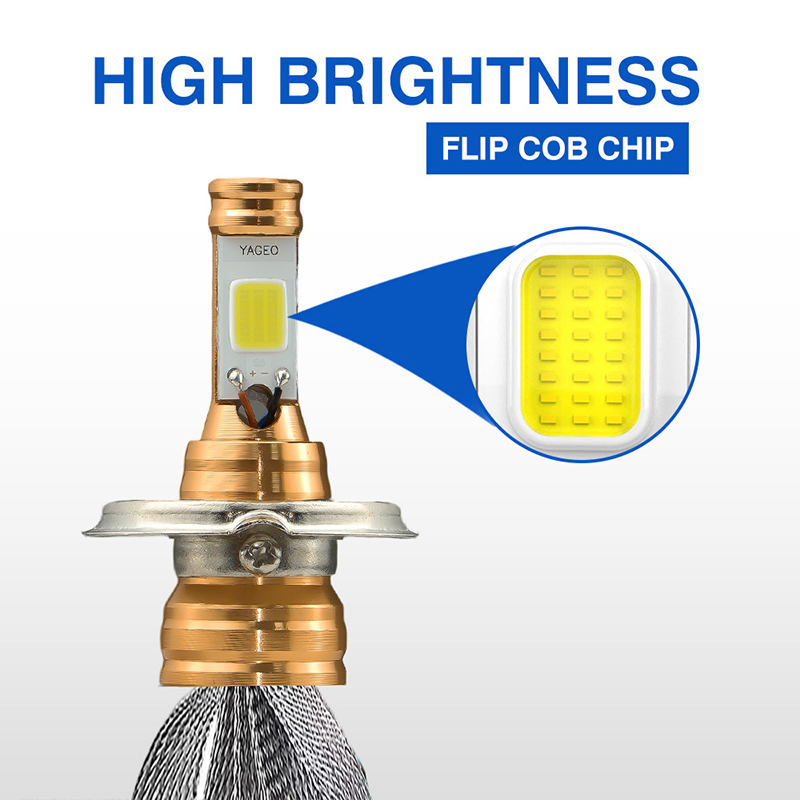
A CSP LED bulb utilizes Chip Scale Package technology. This manufacturing method mounts the diodes directly onto the circuit board. It minimizes thermal resistance and maximizes output density. These specific bulbs equip flexible, tinned copper braids for passive thermal management. You simply spread these braids out to dissipate heat.
This design offers several core advantages. First, it features zero moving parts. No fan means no mechanical failure from dirt or water ingress. Second, it provides highly malleable fitment. You can easily fan out a copper strip LED or tuck it into extremely tight bucket housings. Rigid aluminum heatsinks often fail to fit in these exact same spaces.
However, this technology comes with specific limitations. It relies entirely on your motorcycle's factory reflector bowl to shape the light. If your original reflector is poorly designed, flaking, or degraded, the upgrade will disappoint you. The new bulb will simply amplify a terrible beam pattern.
Best for Naked Bikes: The shallow headlamp buckets on naked streetfighters perfectly suit flexible braids.
Best for Classic Motorcycles: Older bikes often lack the housing space for modern active-cooling fans.
Best for Off-Road: Dirt bikes encounter extreme mud and water, making fanless designs mandatory.
Mini projector LEDs represent a completely different approach to lighting. These drop-in units commonly fit H4 or H7 sockets. They feature a built-in miniature optical glass lens directly on the front of the bulb. This clever design bypasses the motorcycle's stock reflector entirely. The bulb itself shapes and focuses the light beam before it ever hits your original housing.
The optical benefits are substantial. They create a perfect cutoff line. This eliminates random light scatter instantly. It replicates the sharp beam cutoff found on modern luxury vehicles. You will drastically reduce glare for oncoming traffic. Furthermore, they produce a highly focused hotspot. They direct light density exactly where you need it most for safe nighttime riding. This prioritizes usable lux over useless raw lumens.
Despite the excellent optics, you must consider the fitment friction. The physical bulk causes major installation headaches. The front-heavy lens design often strikes the outer glass of shallow housings. Additionally, they usually require larger rear cooling mechanisms. You also face the notorious "Wall of Darkness" effect. Projector cutoffs are incredibly sharp. When you lean the motorcycle deeply into a corner at night, the sharp line tilts. This can severely reduce visibility on the inside of the curve.
The chart below represents a visual performance score (out of 100) for each technology.
Glare Reduction | Projector Lens (95%) CSP Copper Strip (75%) |
Fitment Ease | CSP Copper Strip (90%) Projector Lens (40%) |
Cornering Visibility | CSP Copper Strip (85%) Projector Lens (60%) |
Choosing the right motorcycle LED headlight bulb requires a structured evaluation. You cannot base this decision on internet hype alone. You must examine how each technology interacts with your specific motorcycle architecture.
Thermal management is your first major hurdle. Copper strip passive cooling proves highly reliable over long distances. However, passive cooling may throttle wattage slightly to prevent overheating. This results in a slightly lower maximum brightness. Conversely, high-draw projector units usually require active fan cooling. Fans deliver higher peak performance but introduce a severe mechanical vulnerability.
Optical independence is another critical factor. Mini projectors fix a bad housing immediately. CSP chips, however, require a good housing to function safely. If your current reflector bowl is flaking, rusted, or hazy, you have a problem. A projector lens bypasses the damaged bowl entirely.
Finally, think about vibration resilience. Copper strips absorb high-frequency engine vibrations naturally. They float safely inside the housing. Heavy projector bulbs place much more stress on fragile socket retaining clips. A heavy bulb bouncing over potholes can eventually snap a brittle plastic mounting ring.
Feature | CSP Copper Strip LED | Mini Projector LED |
|---|---|---|
Thermal Solution | Passive (No moving parts) | Active Fan (Usually required) |
Reflector Dependency | High (Needs a clean bowl) | None (Bypasses bowl completely) |
Beam Cutoff | Good (Depends on factory housing) | Perfect (Razor-sharp line) |
Physical Weight | Lightweight (Low clip stress) | Heavy (High clip stress) |
Proper preparation prevents frustrating installation failures. You must perform a rigorous sizing check before buying anything. Grab a set of digital calipers. Measure the depth behind the mounting flange to ensure heat sinks clear the rear cap. Next, measure the distance from the socket to the outer glass lens. Mini projectors often hit the front glass on shallow assemblies.
You must also address CANbus and polarity sensitivity. Modern motorcycles use complex computer networks. Swapping a halogen for an LED changes the electrical resistance. This often triggers dashboard error codes. You may need inline decoders to trick the system. Additionally, note the current type. Some older bikes use AC power directly from the stator to run the headlight. You must install a separate AC/DC rectifier before installing any DC-powered LED. Skipping this step causes violent flickering and rapid bulb death.
Pre-installation maintenance matters immensely. Upgrading the internal light source is totally useless if the outer headlight lens looks heavily oxidized. Yellowed plastic scatters light unpredictably. Restoring hazy headlights is a mandatory step zero. Polish the outer plastic until it looks crystal clear.
Post-install alignment remains the most critical step for your new motorcycle headlamp. A badly aimed LED is a massive safety hazard. Park your bike on level ground exactly 25 feet away from a flat wall. Sit on the bike to compress the suspension naturally. Measure the height from the ground to the center of your headlight bulb. Mark this exact height on the wall with tape. Adjust your housing until the beam cutoff rests two inches below your tape mark. This ensures you illuminate the road instead of passenger car mirrors.
Upgrading your motorcycle lighting requires strategic thinking. Base your final recommendation strictly on housing real estate and reflector health. Choose the flexible copper strip LED for universal fitment, supreme durability, and off-road resilience. Choose the mini projector lens for unmatched optical perfection if you have verified the internal space.
Do not guess your bulb size. Take action today by consulting your motorcycle's factory service manual. Identify your exact socket type before making a purchase. Measure your internal bucket clearances carefully. A deliberate, fitment-first approach guarantees a safer, brighter ride every single time you hit the road after dark.
A: Yes, you can. However, you must select an LED engineered with a 1:1 halogen filament replication. The LED diodes must sit in the exact same physical position as the old tungsten coil. This prevents dangerous glare and utilizes the reflector correctly.
A: This usually happens on older motorcycles. Many classic bikes send AC power directly from the stator to the headlight. LEDs require stable DC power. The AC voltage fluctuation causes rapid flickering at low RPMs. You need an AC/DC rectifier to fix this issue.
A: Legality varies heavily by local jurisdiction. You must check for DOT or ECE compliance in your region. Regardless of the rating, proper downward alignment remains the primary factor in avoiding citations. A properly aimed projector rarely blinds oncoming traffic.